
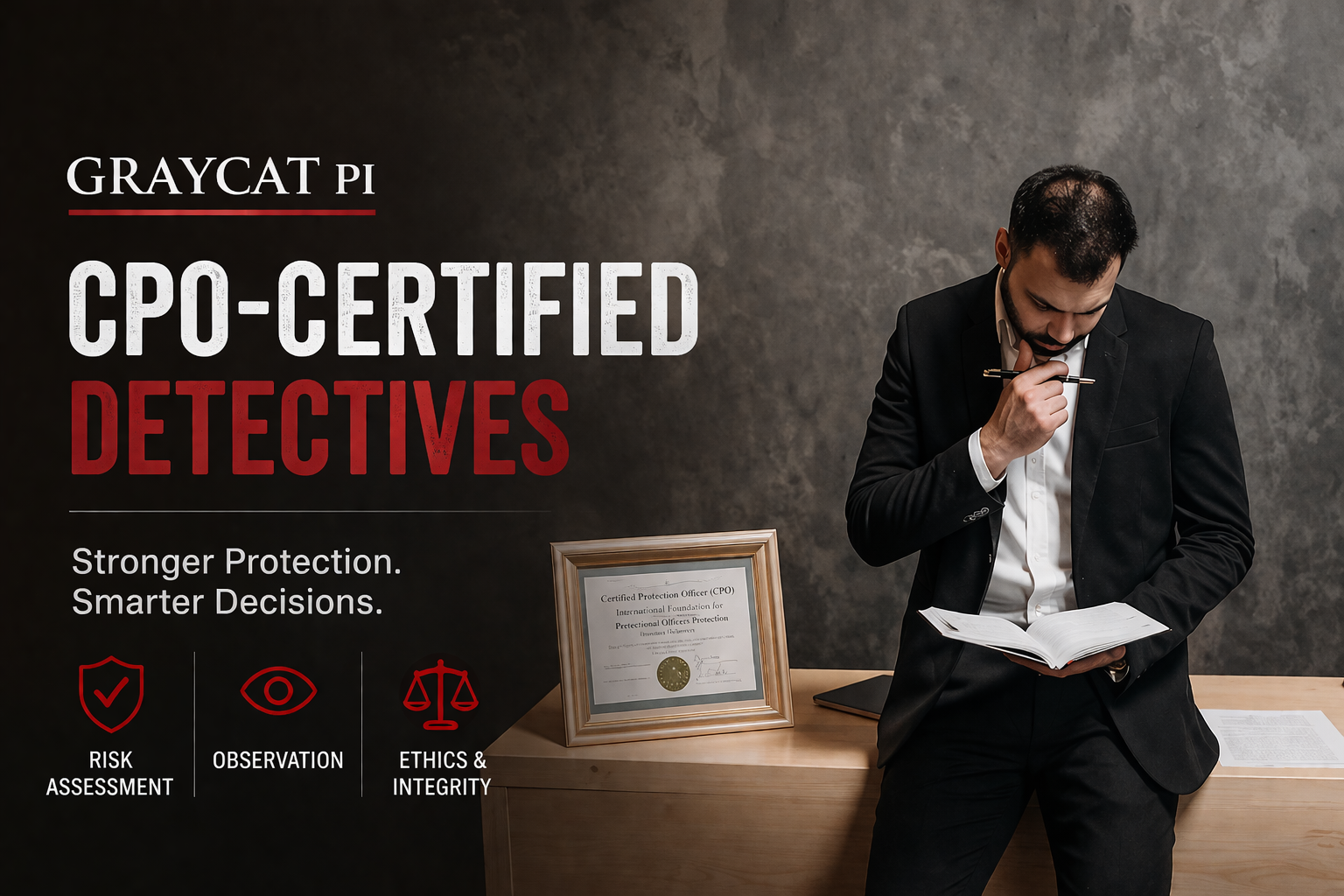
Start with the credential, then check the person
The Certified Protection Officer, or CPO, credential comes from the International Foundation for Protection Officers. It is a security credential, not a private investigator license. IFPO Certified Protection Officer Program
That distinction matters in Mexico.
A client looking for protection-related investigation work should not hire from the credential alone. The decision should rest on licensing, field experience, judgment, legal limits, and the quality of the report the person can produce.
A CPO credential can be a good sign. It is still only one part of the review.
What CPO training actually adds
The CPO program is built around protection work. For a private investigator, the most useful parts are usually observation and risk assessment. The program also covers other security subjects, but those two show up again and again in real assignments.
Most problems are not dramatic. They are procedural. A door stays open. A visitor log is ignored. A camera covers the wrong angle. A guard post has no clear instruction. Staff report incidents late because nobody told them what counts as an incident.
The International Foundation for Protection Officers publishes information about the CPO program and its certification process on its official website. IFPO official website
The people who take this training
CPO training usually attracts people who already work near security and want a more formal structure for the work they are doing. One candidate may come from guard operations and already understand posts, patrols, and incident logs. Another may work in corporate security, where the problems are less visible but often more expensive. Investigators, facility protection staff, risk personnel, and executive protection support teams may also look at the program when their work touches access, exposure, or physical security review.
The common thread is practical responsibility. The person is expected to notice risk, document it, and respond within the role assigned.
For a private investigator, CPO training can add useful structure to physical security work. It can support better site reviews, cleaner observation notes, and more disciplined thinking around access, exposure, and incident response.
It does not replace a license. It does not replace field experience. It does not give a detective powers they do not have under local law.
Risk assessment is usually ordinary work
Risk assessment sounds larger than it is.
In a real assignment, it may mean walking a site, checking entry points, reviewing lighting, looking at access habits, asking who controls keys, and reading the incident log. It may mean watching how people enter a facility during a normal workday.
The best findings are often simple. A warehouse gate has no record of after-hours access. A reception area lets visitors walk past the desk. A manager believes the camera covers the loading area, but the angle misses the door.
None of that requires drama. It requires attention.
Watching without guessing
Observation is where security and investigation overlap.
A trained investigator should know how to watch without creating a scene, record what was seen, and avoid turning a guess into a finding. In protection work, observation may focus on routines, access points, staff movement, vehicles, or behavior around a location.
The report should separate what happened from what the investigator thinks it may mean.
A person standing near an entrance is a fact. The reason they are there may still be unknown.
Emergency response and judgment
The CPO program includes emergency response concepts. That can help in assignments where a client needs a review of procedures, communication, evacuation planning, or incident handling.
For corporate clients, the weak point is often not the written policy. It is what staff do when something happens.
Who calls whom? Who documents the event? Who decides whether to close a site, move an executive, call police, or preserve video? A security professional does not need to make every decision. They need to know where the decision chain breaks.
Security binders tend to look better on shelves than they do during an actual incident.
Sensitive material gets mishandled quietly
Sensitive material gets mishandled in small ways before it becomes a serious problem.
A report includes a home address that did not need to be shared. A photo shows a license plate, a child, or an employee badge in the background. An investigator sends a case update in a casual message thread. A client forwards the report to people who were never part of the assignment, and now private details are moving without control.
Protection assignments can involve travel routines, employee disputes, threats, medical details, family concerns, and internal company weaknesses. Careless wording can expose more than the investigation required. So can careless photos.
CPO training includes ethics and professional conduct. For clients, the credential matters only if the investigator also respects privacy rules, works within legal limits, and writes with restraint. GrayCat PI covers this issue in its guide to legal and ethical private investigation.
Mexico changes the assignment
For a PI firm, CPO training is most useful when the assignment touches security operations.
A fraud matter may require a site check. A corporate dispute may involve access to inventory. An executive protection concern may require a route or venue review. A workplace issue may require observation without disrupting operations.
In those files, the CPO frame can help the investigator look at access, routine, exposure, reporting, and incident response with more discipline.
GrayCat PI values training that supports lawful, documented, and careful work. For clients, the final test is not the acronym after a person’s name. It is the quality of the work, the clarity of the report, and whether the investigator stays inside the assignment.
Security work in Mexico also requires local judgment. A method that seems normal in one country may create problems in another. A site visit may need a different approach depending on the building, the neighborhood, the client’s role, or the risk profile. Private investigators also need to work within Mexican law and licensing limits.
How I would check the person
Before relying on a CPO claim, ask for proof from IFPO and ask what the person has actually done. A certificate is useful, but it does not tell you whether the investigator has handled corporate theft reviews, executive movement, field checks, or site assessments in Mexico.
Ask what the report will include. Ask what methods will not be used. Ask how facts will be separated from assumptions.
A CPO-certified investigator may be a strong fit for protection-related work. A non-certified investigator with strong local experience may also be the better fit for a specific case. The decision should follow the assignment, not the acronym.
If you need security-related investigation support in Mexico, GrayCat PI can review the assignment and tell you what can be verified lawfully. Contact GrayCat PI
Last updated: April 30, 2026
Discover more from GrayCat PI
Subscribe to get the latest posts sent to your email.


